Unraveling the catalase dynamics: Biophysical and computational insights into co-solutes driven stabilization under extreme pH conditions
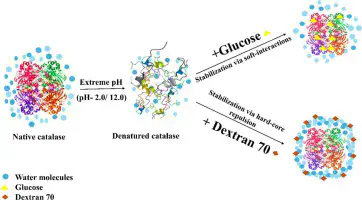 Image credit: Science Direct
Abstract
Catalase plays a vital role in eliminating toxic peroxides from the human body and the environment. The versatile applications of this enzyme extend across biotechnological industries and innovative bioremediation approaches. Nonetheless, ensuring enzyme stability is a challenging task. This study investigated the efficacy of co-solutes (glucose and dextran 70) as stabilizing agents for catalase under denaturing pH conditions by employing a combination of spectroscopic techniques (UV‐visible, circular dichroism, and Trp fluorescence), calorimetric measurements (DSC and ITC), enzymatic assay, and in silico studies. The results of spectroscopic and thermal stability studies indicated that the co-solutes tend to stabilize catalase, even under extreme pH conditions. Molecular docking and ITC findings showed that glucose has a higher binding tendency to catalase than dextran 70. MD simulations further underscore reduced structural deviations (RMSF and RMSD), compact structure (Rg and SASA), and formation of H-bonds between catalase and co-solutes, complementing the in vitro observations. This study contributes to the understanding of enzyme stability under suboptimal pH conditions and paves the way for the development of more robust enzyme formulations suitable for a range of applications.